Most organizations do not struggle with ideas.
They struggle with execution.
Marketing teams, agencies, educational institutions, nonprofits, sales organizations, and internal communication departments all face a similar challenge:
How do you consistently produce, manage, distribute, and maintain large volumes of content?
This challenge is known as Content Operations, often shortened to Content Ops.
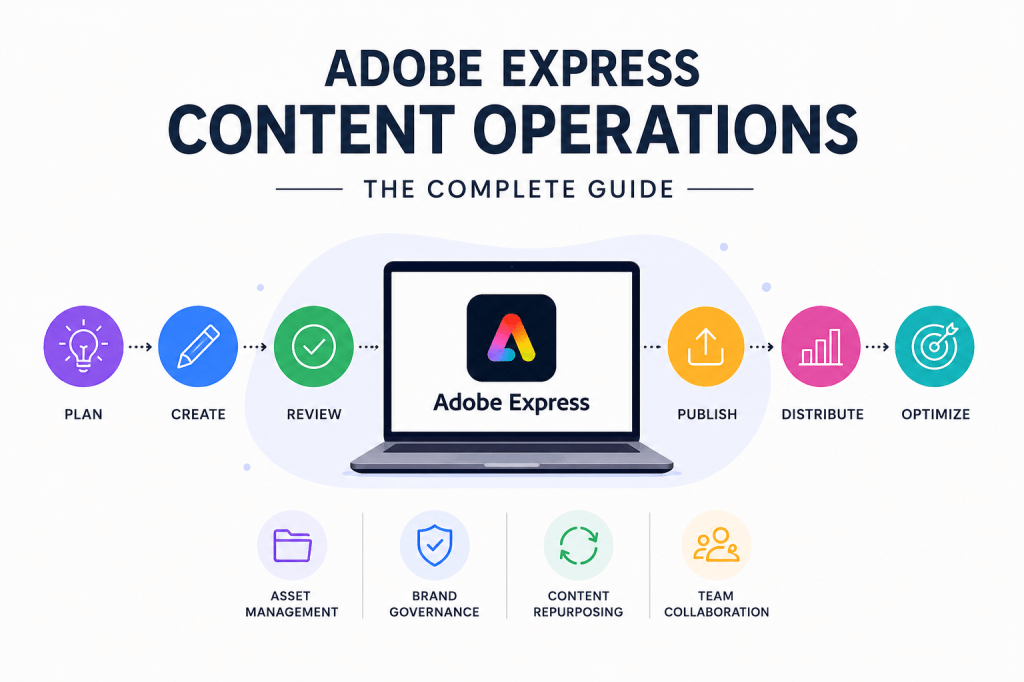
Content Operations focuses on the systems, workflows, people, technology, and processes that enable content production at scale.
Adobe Express can play a central role in Content Operations by helping teams create, standardize, repurpose, manage, and distribute content efficiently.
This guide explains how Adobe Express supports Content Operations and how organizations can build scalable content systems.
What Is Content Operations?
Content Operations is the discipline of managing the entire content lifecycle.
It focuses on:
- Planning
- Creation
- Review
- Approval
- Publishing
- Maintenance
- Optimization
The goal is not simply to create content.
The goal is to create content consistently, efficiently, and at scale.
Why Content Operations Matters
Many organizations eventually reach a point where content becomes difficult to manage.
Common symptoms include:
Content Bottlenecks
Teams cannot produce assets fast enough.
Duplicate Work
Multiple people create similar content.
Inconsistent Branding
Assets vary across departments.
Missed Deadlines
Publishing schedules slip.
Poor Visibility
No one knows what content exists.
Content Operations helps solve these problems.
Content Creation vs Content Operations
These concepts are often confused.
Content Creation
Creating:
- Articles
- Videos
- Graphics
- Presentations
Content Operations
Managing:
- Workflows
- Templates
- Asset libraries
- Governance
- Production systems
Content creation produces assets.
Content Operations creates the environment that enables asset production.
Why Adobe Express Supports Content Operations
Adobe Express combines several critical capabilities:
- Templates
- Brand Kits
- AI-powered content creation
- Video production
- Content repurposing
- Collaboration tools
Together, these features help organizations create repeatable content systems.
The Content Operations Framework
Successful Content Operations usually includes seven components.
1. Content Planning
Every content operation begins with planning.
Examples include:
Editorial Calendars
Organize publishing schedules.
Campaign Plans
Coordinate marketing initiatives.
Content Roadmaps
Align efforts with business goals.
Adobe Express works well alongside content planning processes.
2. Content Creation
This is where content is produced.
Examples include:
- Graphics
- Videos
- Presentations
- Social media assets
Adobe Express helps teams create these assets efficiently.
3. Brand Governance
Content should remain consistent.
Adobe Express Brand Kits help standardize:
- Logos
- Colors
- Fonts
- Visual identity
Brand governance is essential for scale.
4. Asset Management
Organizations produce thousands of assets over time.
Examples include:
- Images
- Videos
- Presentations
- Templates
Content Operations requires structured asset management.
Adobe Express helps centralize many content resources.
5. Content Repurposing
One of the highest-value Content Ops activities.
Example:
Original asset:
Webinar.
Repurposed into:
- Blog article
- LinkedIn posts
- Infographic
- Video clips
- Newsletter content
Adobe Express simplifies these transformations.
6. Distribution
Content must reach audiences.
Examples include:
- Social media
- Websites
- Internal communications
Content Operations ensures content moves efficiently from creation to publication.
7. Performance Optimization
Successful teams measure:
- Engagement
- Reach
- Adoption
- Conversions
These insights improve future content.
Content Operations for Marketing Teams
Marketing departments often create:
- Campaign assets
- Product launches
- Social media content
- Educational resources
Content Operations helps coordinate these activities.
Adobe Express supports consistency through templates and Brand Kits.
Content Operations for Agencies
Agencies face unique challenges.
They often manage:
- Multiple clients
- Multiple brands
- Multiple campaigns
Adobe Express helps agencies standardize production processes and reduce complexity.
Content Operations for Enterprises
Large organizations frequently struggle with:
Decentralized Content
Teams create assets independently.
Asset Fragmentation
Resources become difficult to find.
Brand Drift
Standards become inconsistent.
Adobe Express helps support centralized content systems.
Content Operations for Educational Organizations
Educational institutions create:
- Course materials
- Learning resources
- Internal communications
- Promotional content
Content Operations helps organize and scale these efforts.
Building a Content Operations System
A practical Content Ops framework might include:
Step 1: Establish Brand Standards
Create Brand Kits.
Step 2: Develop Template Libraries
Standardize common assets.
Step 3: Build Content Calendars
Coordinate production.
Step 4: Create Review Processes
Improve quality control.
Step 5: Implement Asset Management
Organize resources.
Step 6: Measure Performance
Optimize continuously.
Adobe Express supports each stage.
Template Libraries as Operational Assets
Templates are foundational to Content Operations.
Examples include:
Social Media Templates
Support publishing consistency.
Presentation Templates
Standardize communications.
Event Templates
Accelerate promotions.
Training Templates
Support educational initiatives.
Templates reduce repetitive work.
AI and Content Operations
Artificial intelligence is transforming content production.
Adobe Express AI supports:
Content Generation
Create initial drafts.
Idea Development
Generate concepts.
Content Adaptation
Modify assets for different channels.
Productivity Improvements
Reduce manual effort.
AI increasingly functions as a Content Ops accelerator.
Content Repurposing Systems
One of the most effective Content Ops strategies.
Example:
Original asset:
Product webinar.
Outputs:
- Blog article
- LinkedIn posts
- Video clips
- Infographic
- Sales presentation
Adobe Express helps automate portions of this process.
Workflow Standardization
Content Operations depends on repeatable workflows.
Example:
Request
Content needed.
Planning
Requirements defined.
Creation
Assets produced.
Review
Quality control.
Publishing
Distribution.
Measurement
Performance evaluation.
Standardization improves scalability.
Measuring Content Operations
Important metrics include:
Production Speed
Time required to create content.
Asset Utilization
Reuse of existing resources.
Brand Compliance
Consistency of content.
Publishing Frequency
Content output volume.
Team Productivity
Operational efficiency.
These metrics help identify bottlenecks.
Common Content Operations Challenges
Lack of Governance
Creates inconsistency.
Too Many Tools
Complex workflows reduce efficiency.
Weak Asset Management
Resources become difficult to locate.
Poor Documentation
Processes become unclear.
Limited Repurposing
Content value remains underutilized.
Example Content Operations Workflow
Imagine a product launch.
Planning
Define campaign.
Asset Creation
Develop content.
Branding
Apply standards.
Repurposing
Generate supporting assets.
Publishing
Launch across channels.
Measurement
Analyze results.
Adobe Express supports many of these stages.
Adobe Express vs Traditional Content Operations
| Feature | Adobe Express | Traditional Workflow |
|---|---|---|
| Templates | Centralized | Variable |
| Brand Management | Strong | Often Manual |
| AI Assistance | Built-In | Separate Tools |
| Content Repurposing | Efficient | More Manual |
| Asset Creation | Fast | Slower |
| Team Accessibility | High | Moderate |
Adobe Express reduces operational friction significantly.
Future of Content Operations
Several trends are shaping Content Ops:
- AI-assisted content production
- Automated workflows
- Intelligent asset management
- Personalized content systems
- Cross-channel orchestration
Content Operations is becoming increasingly strategic.
Adobe Express is evolving alongside these trends.
Content Operations Maturity Model
Organizations typically progress through four stages:
Level 1: Ad Hoc
Content created without structure.
Level 2: Organized
Templates and calendars introduced.
Level 3: Standardized
Workflows documented.
Level 4: Optimized
AI and automation support scale.
Adobe Express can support progression through all stages.
Conclusion
Content Operations is the foundation that allows organizations to create, manage, and scale content effectively.
Adobe Express supports Content Operations through templates, Brand Kits, AI-powered content creation, content repurposing workflows, video production capabilities, and centralized asset management.
Whether supporting marketing teams, agencies, educational institutions, nonprofits, or enterprise organizations, Adobe Express helps transform content creation from a collection of isolated activities into a scalable operational system.
As content demands continue to grow, organizations that invest in Content Operations will be better positioned to maintain quality, consistency, and productivity.
Related Guides
- Adobe Express Creative Operations
- Adobe Express Brand Management
- Adobe Express Campaign Management
- Adobe Express Marketing Automation
- Adobe Express Content Calendars
- Adobe Express Team Collaboration
- Adobe Express Workflow Automation
- Adobe Express Digital Asset Management
- Adobe Express Enterprise Workflows
- Building an AI Content Publishing System with Adobe Express







 Acrobat Express Pro