Marketing teams are under pressure to produce more content, manage more channels, support more campaigns, and respond faster than ever before.
At the same time, budgets and staffing often remain constrained.
The solution many organizations are pursuing is marketing automation.
Marketing automation is no longer limited to email sequences and CRM workflows. Modern automation includes:
- Content creation
- Asset production
- Brand management
- Content repurposing
- Publishing workflows
- Campaign execution
- AI-assisted content generation
Adobe Express plays an increasingly important role in these workflows by serving as a content creation and production platform that helps marketing teams automate repetitive tasks while maintaining quality and consistency.
This guide explores how Adobe Express supports marketing automation and how organizations can build scalable marketing systems around it.
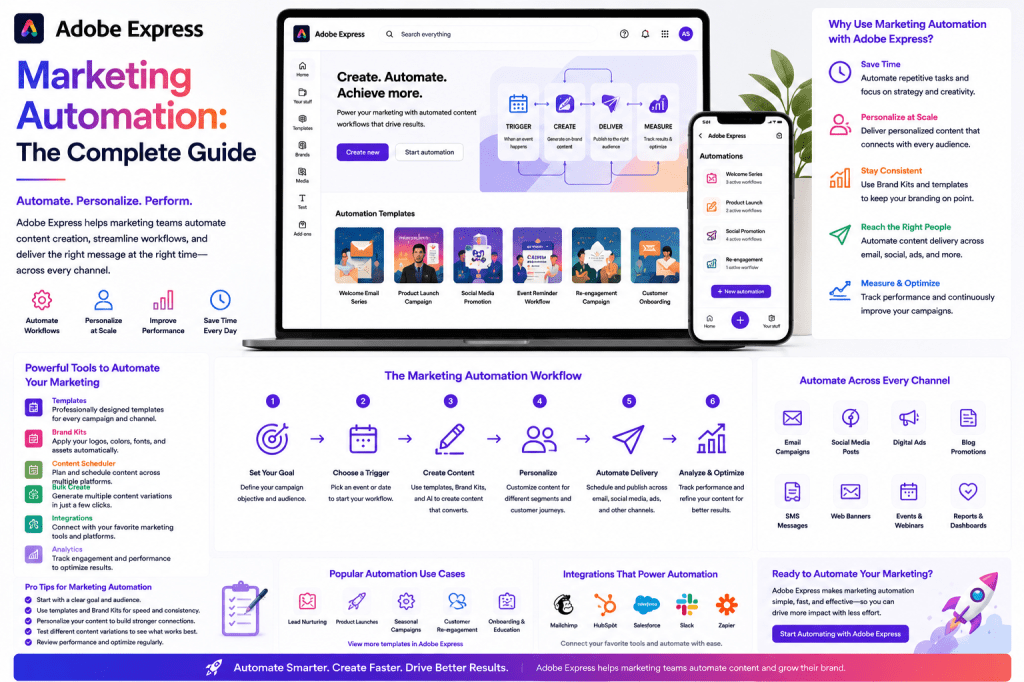
What Is Marketing Automation?
Marketing automation refers to the use of technology to reduce manual effort in marketing processes.
The goal is to automate repetitive activities while allowing marketers to focus on strategy and creativity.
Common examples include:
- Email campaigns
- Lead nurturing
- Social media scheduling
- Content production
- Campaign workflows
- Reporting
Marketing automation helps organizations scale their efforts without proportionally increasing workload.
Why Marketing Automation Matters
Without automation, marketing teams often struggle with:
Repetitive Tasks
Creating similar assets repeatedly.
Inconsistent Execution
Campaigns are delivered differently each time.
Content Bottlenecks
Production delays slow campaigns.
Limited Scalability
Output depends heavily on manual effort.
Automation helps address these challenges.
Where Adobe Express Fits
Adobe Express is not a traditional marketing automation platform like a CRM or email marketing system.
Instead, it automates a different part of the marketing process:
Content production.
Adobe Express helps automate:
- Graphic creation
- Content generation
- Brand application
- Asset adaptation
- Content repurposing
- Publishing preparation
This makes it a critical component of modern marketing operations.
The Adobe Express Automation Framework
Marketing automation with Adobe Express can be divided into six areas.
1. Content Ideation Automation
Creating content ideas consistently is difficult.
Adobe Express AI can help generate:
- Blog topics
- Social media ideas
- Campaign concepts
- Educational content
- Promotional themes
Example prompt:
Generate 30 LinkedIn post ideas for a cybersecurity consulting company.
This significantly reduces planning effort.
2. Content Creation Automation
One of the most time-consuming marketing activities is content production.
Adobe Express AI helps automate:
Headlines
Generate multiple options quickly.
Social Media Posts
Create draft captions.
Marketing Messages
Develop campaign content.
Promotional Copy
Generate descriptions and calls-to-action.
Marketers spend less time starting from scratch.
3. Design Automation
Many marketing assets follow similar patterns.
Examples include:
- Social media graphics
- Event announcements
- Product promotions
- Educational visuals
Adobe Express templates automate much of the design process.
Instead of rebuilding layouts repeatedly, teams customize reusable designs.
4. Brand Automation
Brand consistency is essential.
Adobe Express Brand Kits automate:
- Color selection
- Font application
- Logo placement
- Visual identity standards
Benefits include:
Faster Production
No manual brand configuration.
Better Consistency
Every asset follows guidelines.
Reduced Errors
Incorrect branding becomes less likely.
5. Content Repurposing Automation
Repurposing is one of the highest-leverage marketing activities.
Example:
Original asset:
Blog article.
Repurposed assets:
- LinkedIn posts
- Instagram carousel
- Infographic
- Video summary
- Email content
Adobe Express significantly accelerates this process.
6. Publishing Preparation Automation
Publishing often requires:
- Multiple image sizes
- Different formats
- Channel-specific assets
Adobe Express helps automate:
Resizing
Adapt content for multiple platforms.
Asset Creation
Generate variations quickly.
Brand Application
Maintain consistency across channels.
This reduces publishing workload.
Building a Marketing Automation System
Successful automation starts with a structured workflow.
Step 1: Define Content Pillars
Examples:
Educational Content
Teach your audience.
Product Marketing
Promote offerings.
Industry Insights
Discuss trends.
Customer Stories
Show results.
Content pillars create consistency.
Step 2: Create Templates
Develop reusable assets for:
- LinkedIn posts
- Carousels
- Webinars
- Product announcements
Templates reduce repetitive work.
Step 3: Configure Brand Kits
Centralize:
- Logos
- Colors
- Fonts
- Visual assets
This supports automated branding.
Step 4: Create Content Workflows
Define repeatable processes.
Example:
Idea → Content → Graphics → Repurposing → Publishing
Workflows improve scalability.
Marketing Automation for Small Businesses
Small businesses often lack dedicated marketing teams.
Adobe Express helps owners automate:
- Content creation
- Social media graphics
- Promotional campaigns
- Educational content
This increases output without requiring additional staff.
Marketing Automation for Agencies
Agencies manage multiple clients simultaneously.
Automation supports:
Faster Production
More content per client.
Better Consistency
Brand Kits for each client.
Improved Profitability
Reduced production effort.
Adobe Express helps agencies scale efficiently.
Marketing Automation for Marketing Teams
Internal marketing departments can automate:
- Campaign asset creation
- Content production
- Brand management
- Social media workflows
This reduces operational bottlenecks.
AI-Powered Campaign Automation
AI increasingly supports campaign creation.
Examples include:
Campaign Ideas
Generate themes.
Messaging Variations
Create multiple versions.
Social Content
Produce supporting assets.
Promotional Graphics
Accelerate visual creation.
Adobe Express AI helps marketers move from concept to execution more quickly.
Example Marketing Automation Workflow
Imagine a product launch campaign.
Traditional Process
Create:
- Graphics
- Social posts
- Presentation materials
- Promotional content
individually.
Automated Process
Use:
- AI-generated messaging
- Templates
- Brand Kits
- Content repurposing
Result:
Faster execution with greater consistency.
Content Calendar Automation
Adobe Express works particularly well with content calendars.
Example workflow:
Monthly Planning
Generate ideas.
Weekly Production
Create assets.
Repurposing
Expand content reach.
Publishing
Distribute consistently.
Automation helps maintain momentum.
Marketing Automation Metrics
Success should be measured through:
Content Output
Assets produced.
Production Speed
Time required.
Consistency
Publishing regularity.
Engagement
Audience response.
ROI
Business impact.
Automation should improve each of these areas.
Common Automation Mistakes
Automating Poor Processes
Automation improves systems.
It does not fix broken ones.
Ignoring Brand Standards
Automation should strengthen consistency.
Overusing AI
Human review remains essential.
Creating Too Many Variations
Focus on quality over quantity.
Lack of Documentation
Workflows should be clearly defined.
Building an AI Marketing Engine
A practical Adobe Express marketing engine might include:
AI Ideation
Generate topics.
Templates
Accelerate design.
Brand Kits
Ensure consistency.
Repurposing
Multiply content value.
Content Calendars
Maintain structure.
Publishing
Distribute efficiently.
Together these components create a scalable marketing system.
Adobe Express and Marketing Operations
Marketing operations teams focus on:
- Efficiency
- Consistency
- Scalability
Adobe Express aligns well with these objectives.
It helps transform content production from a collection of isolated activities into a repeatable operational process.
Future of Marketing Automation
Several trends are shaping the future:
- AI-generated campaigns
- Automated content adaptation
- Intelligent scheduling
- Personalized content
- Creative workflow orchestration
Adobe Express continues to evolve toward supporting these capabilities.
Conclusion
Marketing automation is increasingly essential for organizations seeking to scale content production without dramatically increasing resources.
Adobe Express supports this goal through AI-assisted content creation, templates, Brand Kits, content repurposing workflows, and streamlined asset production.
While it is not a traditional automation platform, it automates one of the most time-consuming aspects of marketing: content creation.
Organizations that combine Adobe Express with structured workflows, content calendars, and automation principles can dramatically improve productivity, consistency, and marketing effectiveness.
As marketing continues to evolve toward AI-assisted operations, Adobe Express is becoming a valuable component of the modern marketing technology stack.
Related Guides
- Adobe Express AI Assistant
- Adobe Express Productivity Workflows
- Adobe Express Content Calendars
- Adobe Express Content Repurposing
- Adobe Express Templates
- Adobe Express Brand Kits
- Adobe Express for Marketing Teams
- Adobe Express for Agencies
- Adobe Express for LinkedIn Marketing
- Building an AI Content Publishing System with Adobe Express







 Acrobat Express Pro