Remote work has transformed how organizations operate.
Teams are no longer limited to a single office or location. Employees collaborate across cities, countries, and time zones while working from homes, coworking spaces, client sites, and regional offices.
While remote work offers flexibility and access to global talent, it also introduces new challenges.
Organizations must overcome:
- Communication gaps
- Information silos
- Collaboration difficulties
- Inconsistent branding
- Content management issues
- Productivity concerns
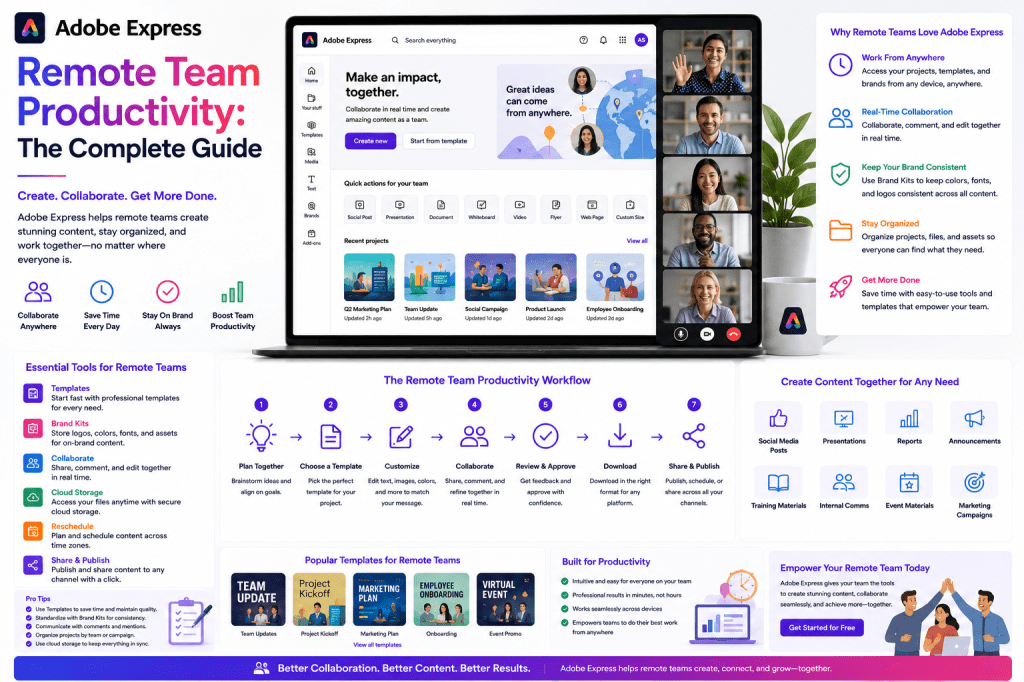
Adobe Express helps remote teams stay aligned through visual communication, shared branding, content creation workflows, templates, AI-powered tools, and collaborative content systems.
This guide explores how Adobe Express supports remote team productivity and helps distributed organizations work more effectively.
What Is Remote Team Productivity?
Remote team productivity refers to a team’s ability to achieve goals effectively while working from different locations.
Productive remote teams:
- Communicate clearly
- Share information efficiently
- Collaborate effectively
- Maintain consistency
- Deliver results on time
Technology plays a critical role in enabling these outcomes.
Why Remote Productivity Matters
Remote work is no longer a temporary trend.
Many organizations now operate:
Fully Remote
No central office.
Hybrid
Combination of office and remote work.
Distributed
Employees across multiple locations.
As these models become more common, productivity systems become increasingly important.
Common Remote Work Challenges
Remote teams often experience:
Communication Delays
Information moves slower.
Reduced Visibility
Work becomes harder to track.
Collaboration Friction
Teams struggle to coordinate.
Content Fragmentation
Assets become scattered.
Brand Inconsistency
Different employees create content differently.
Adobe Express helps address these challenges through standardized content creation and visual communication.
Why Adobe Express Supports Remote Teams
Adobe Express provides:
- Templates
- Brand Kits
- Shared content resources
- AI-powered content creation
- Video production tools
- Content repurposing workflows
These capabilities help distributed teams remain aligned.
The Remote Productivity Framework
Successful remote organizations often focus on six key areas.
1. Communication
Communication is the foundation of remote work.
Teams need:
Clear Messaging
Reduce misunderstandings.
Consistent Updates
Maintain alignment.
Accessible Resources
Improve information sharing.
Adobe Express helps teams create clear visual communications.
2. Collaboration
Remote teams depend on collaboration systems.
Examples include:
- Shared templates
- Standardized assets
- Brand resources
- Content libraries
Collaboration becomes easier when teams use common resources.
3. Documentation
Remote organizations rely heavily on documentation.
Examples include:
Processes
How work is completed.
Training
How employees learn.
Best Practices
Operational guidance.
Policies
Organizational standards.
Adobe Express helps transform documentation into engaging visual resources.
4. Content Creation
Remote teams frequently create:
- Presentations
- Marketing assets
- Internal communications
- Educational content
Adobe Express provides a shared content creation platform.
5. Standardization
Consistency improves productivity.
Examples include:
Templates
Reusable structures.
Brand Kits
Approved visual standards.
Workflow Processes
Repeatable systems.
Standardization reduces confusion.
6. Automation
Automation reduces manual work.
Examples include:
- AI-generated content
- Content repurposing
- Asset adaptation
- Workflow optimization
Adobe Express supports productivity through automation-friendly features.
Remote Team Communication
Communication is often the biggest challenge for distributed organizations.
Adobe Express helps teams create:
Company Announcements
Improve visibility.
Leadership Updates
Increase transparency.
Team Presentations
Share information effectively.
Visual Summaries
Reduce information overload.
Visual communication improves understanding.
Remote Team Collaboration
Distributed teams frequently work together across departments.
Examples include:
Marketing
Campaign creation.
Sales
Customer communications.
HR
Employee engagement.
Customer Success
Training and onboarding.
Adobe Express helps create shared content systems.
Visual Communication for Remote Teams
Visual content often communicates more effectively than text alone.
Examples include:
Infographics
Simplify information.
Process Diagrams
Explain workflows.
Visual Updates
Highlight priorities.
Educational Graphics
Support learning.
Adobe Express makes visual communication accessible to all employees.
Remote Team Training
Training is essential in distributed organizations.
Examples include:
- Employee onboarding
- Skills development
- Process education
- Compliance programs
Adobe Express supports training through:
Presentations
Structured learning.
Videos
Flexible education.
Visual Guides
Quick reference resources.
Remote Employee Onboarding
New employees require support.
Remote onboarding often includes:
Welcome Materials
Company introduction.
Training Content
Role-specific education.
Team Resources
Organizational structure.
Process Documentation
Operational guidance.
Adobe Express helps create engaging onboarding experiences.
Remote Team Knowledge Sharing
Knowledge sharing is especially important for remote organizations.
Examples include:
Best Practices
Operational improvements.
Process Updates
Organizational changes.
Learning Resources
Professional development.
Internal Communications
Company-wide alignment.
Adobe Express supports visual knowledge sharing.
AI-Powered Remote Productivity
Adobe Express AI helps remote teams work more efficiently.
Examples include:
Content Drafting
Generate first versions.
Communication Assistance
Create announcements.
Idea Generation
Support collaboration.
Asset Creation
Reduce manual effort.
AI helps remote teams scale productivity.
Brand Consistency Across Remote Teams
Remote employees often create content independently.
Brand Kits help ensure:
Consistent Logos
Approved assets only.
Standard Colors
Visual alignment.
Unified Typography
Professional appearance.
Shared Identity
Stronger organizational branding.
Brand consistency becomes easier to maintain.
Building a Remote Productivity System
A practical framework may include:
Step 1
Define communication standards.
Step 2
Create Brand Kits.
Step 3
Develop template libraries.
Step 4
Build documentation systems.
Step 5
Use AI productivity tools.
Step 6
Measure outcomes.
Adobe Express supports each stage.
Content Repurposing for Remote Teams
Remote teams often benefit from content reuse.
Example:
Original asset:
Company town hall presentation.
Repurposed into:
- Employee newsletter
- Infographic
- Training resource
- Leadership update
- Video summary
Adobe Express helps maximize content value.
Measuring Remote Team Productivity
Organizations should monitor:
Employee Engagement
Participation levels.
Communication Reach
Message visibility.
Content Usage
Asset consumption.
Training Completion
Learning effectiveness.
Productivity Metrics
Operational outcomes.
Measurement supports continuous improvement.
Common Remote Productivity Mistakes
Poor Communication
Creates confusion.
Weak Documentation
Knowledge becomes inaccessible.
Inconsistent Content
Reduces professionalism
Excessive Meetings
Decreases productivity.
Lack of Standards
Creates inefficiencies.
Example Remote Team Workflow
Imagine a distributed marketing team.
Planning
Campaign objectives defined.
Creation
Templates accelerate content.
Branding
Brand Kits maintain consistency.
Review
Stakeholders provide feedback.
Publishing
Assets distributed.
Repurposing
Content reused across channels.
Adobe Express supports every stage.
Adobe Express vs Traditional Remote Workflows
| Feature | Adobe Express | Traditional Workflow |
|---|---|---|
| Templates | Centralized | Fragmented |
| Branding | Brand Kits | Manual |
| Video Creation | Built-In | Separate Tools |
| AI Assistance | Available | Limited |
| Content Repurposing | Easy | Time-Consuming |
| Team Accessibility | High | Variable |
Adobe Express helps reduce friction in distributed environments.
Future of Remote Team Productivity
Several trends are shaping remote work:
- AI-assisted collaboration
- Asynchronous communication
- Visual-first knowledge sharing
- Automated workflows
- Distributed content operations
Organizations that embrace these trends will operate more effectively.
Remote Productivity Maturity Model
Level 1: Reactive
Work managed individually.
Level 2: Organized
Templates and documentation introduced.
Level 3: Standardized
Workflows formalized.
Level 4: Optimized
AI and automation support scale.
Adobe Express helps organizations advance through all stages.
Conclusion
Remote work has permanently changed how organizations operate.
Success now depends on effective communication, collaboration, knowledge sharing, content creation, and workflow management across distributed teams.
Adobe Express helps remote organizations improve productivity through templates, Brand Kits, AI-powered tools, visual communication capabilities, video creation features, and content repurposing workflows.
Whether supporting internal communications, onboarding, training, marketing, customer success, or enterprise operations, Adobe Express provides a practical platform for helping remote teams stay aligned, productive, and connected.
As distributed work continues to evolve, organizations that invest in remote productivity systems will be better positioned to succeed.
Related Guides
- Adobe Express Team Collaboration
- Adobe Express Knowledge Sharing
- Adobe Express Business Productivity
- Adobe Express AI Productivity
- Adobe Express Workflow Automation
- Adobe Express Enterprise Workflows
- Adobe Express Content Operations
- Adobe Express Internal Communications
- Adobe Express Digital Asset Management
- Adobe Express Visual Communication