Introduction
Large organizations create an enormous amount of content.
Every day, teams produce:
- Marketing campaigns
- Sales presentations
- HR communications
- Training materials
- Customer onboarding resources
- Executive updates
- Product launch assets
- Internal communications
As organizations scale, content creation becomes more than a creative challenge—it becomes a workflow challenge.
Without structured workflows, businesses often experience:
- Duplicate work
- Content bottlenecks
- Brand inconsistency
- Delayed approvals
- Missed deadlines
- Reduced productivity
This is where Enterprise Workflows become critical.
Adobe Express helps organizations streamline content production through templates, Brand Kits, AI-powered tools, collaboration features, and standardized content creation systems.
This guide explores how Adobe Express supports enterprise workflows across departments and business functions.
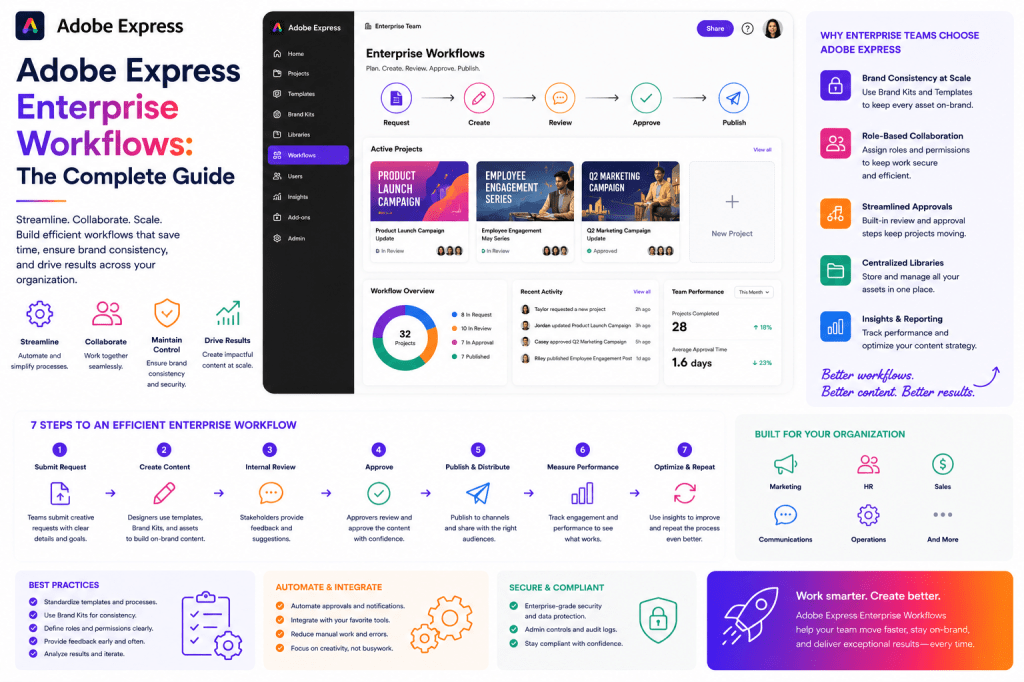
What Are Enterprise Workflows?
Enterprise workflows are structured processes that help organizations manage work consistently and efficiently.
A workflow defines:
- Who performs a task
- When it is performed
- How it moves between teams
- What approvals are required
- How outcomes are measured
Workflows reduce uncertainty and improve operational efficiency.
Why Enterprise Workflows Matter
As companies grow, complexity increases.
A small business may have:
- One marketer
- One designer
- One manager
A large enterprise may have:
- Hundreds of employees
- Multiple departments
- Regional teams
- External agencies
- Global operations
Without workflows, coordination becomes difficult.
Enterprise workflows create structure.
Common Enterprise Workflow Challenges
Organizations often encounter:
Content Bottlenecks
Projects wait for approvals.
Brand Inconsistency
Teams create assets differently.
Asset Duplication
Similar content is recreated repeatedly.
Poor Visibility
Stakeholders lack insight into progress.
Communication Gaps
Teams work in silos.
Adobe Express can help reduce many of these challenges.
Why Adobe Express Supports Enterprise Workflows
Adobe Express combines several important capabilities:
- Templates
- Brand Kits
- AI-assisted content creation
- Video production
- Asset reuse
- Content repurposing
- Collaboration support
These capabilities help standardize content production across teams.
The Enterprise Workflow Framework
Successful enterprise workflows often include six stages.
1. Request
Every workflow starts with a need.
Examples include:
- Marketing campaign request
- HR communication request
- Product launch initiative
- Sales presentation requirement
Clear requests improve workflow efficiency.
2. Planning
Requirements are defined.
Examples:
Objectives
What is the goal?
Audience
Who will receive the content?
Deliverables
What assets are required?
Timeline
When is completion expected?
Planning reduces rework.
3. Creation
Content is produced.
Examples include:
- Graphics
- Videos
- Presentations
- Social media assets
- Training materials
Adobe Express helps accelerate this stage.
4. Review
Stakeholders evaluate content.
Review often includes:
- Brand compliance
- Accuracy checks
- Legal approval
- Leadership feedback
Standardized workflows improve review efficiency.
5. Approval
Final authorization is provided.
Approved assets move to distribution.
Clear approval processes reduce delays.
6. Distribution
Content is published or delivered.
Examples include:
- Social media
- Email campaigns
- Internal communications
- Learning platforms
- Customer communications
Distribution completes the workflow.
Enterprise Marketing Workflows
Marketing teams create large volumes of content.
Examples include:
Campaigns
Multi-channel initiatives.
Product Launches
Promotional activities.
Brand Awareness Programs
Educational content.
Demand Generation
Lead acquisition efforts.
Adobe Express supports marketing workflow standardization.
Enterprise HR Workflows
HR departments frequently create:
- Recruitment campaigns
- Employee communications
- Onboarding resources
- Training content
Adobe Express helps HR teams maintain consistency across materials.
Enterprise Sales Workflows
Sales teams rely on:
- Presentations
- Customer communications
- Proposal support materials
- Product overviews
Adobe Express enables standardized sales content creation.
Enterprise Customer Success Workflows
Customer Success teams often produce:
- Onboarding materials
- Training resources
- Product adoption campaigns
- Customer communications
Workflow consistency improves customer experiences.
Brand Governance Across Enterprise Workflows
Brand consistency is critical.
Adobe Express Brand Kits help standardize:
Logos
Approved versions.
Colors
Brand palettes.
Fonts
Typography standards.
Visual Elements
Consistent design language.
Brand governance becomes easier when assets are centralized.
Template Libraries for Enterprise Teams
Templates are foundational workflow assets.
Examples include:
Marketing Templates
Campaign graphics.
Sales Templates
Presentations and customer materials.
HR Templates
Recruitment and onboarding content.
Internal Communication Templates
Employee announcements.
Templates reduce production effort significantly.
AI-Powered Enterprise Workflows
Artificial intelligence is becoming an important workflow component.
Adobe Express AI can assist with:
Content Drafting
Generate starting points.
Content Adaptation
Customize materials.
Messaging Development
Create variations.
Content Repurposing
Extend asset value.
AI improves workflow efficiency.
Cross-Department Collaboration
Enterprise content often requires collaboration between:
- Marketing
- Sales
- HR
- Product teams
- Customer Success
- Leadership
Adobe Express helps provide a shared content creation environment.
This reduces fragmentation.
Enterprise Content Repurposing
One of the most effective workflow strategies.
Example:
Original asset:
Product launch webinar.
Repurposed into:
- Social media posts
- Sales presentations
- Training materials
- Customer guides
- Internal communications
Adobe Express helps maximize content utilization.
Workflow Standardization
Standardization improves:
Speed
Faster production.
Quality
More consistent output.
Scalability
Support for growth.
Governance
Better compliance.
Adobe Express templates and Brand Kits support standardization efforts.
Measuring Enterprise Workflow Performance
Key metrics include:
Production Speed
Time to completion.
Approval Time
Review efficiency.
Asset Reuse
Content utilization.
Brand Compliance
Consistency levels.
Team Productivity
Operational effectiveness.
Measurement helps identify improvement opportunities.
Common Enterprise Workflow Mistakes
No Defined Process
Creates confusion.
Excessive Approval Layers
Slows execution.
Poor Asset Organization
Makes content difficult to locate.
Weak Governance
Reduces consistency.
Lack of Automation
Increases manual effort.
Example Enterprise Workflow
Imagine a company launching a new service.
Request
Launch campaign initiated.
Planning
Objectives defined.
Asset Creation
Content developed.
Review
Stakeholder feedback collected.
Approval
Final authorization provided.
Distribution
Assets deployed.
Adobe Express can support every stage.
Adobe Express vs Traditional Enterprise Content Workflows
| Feature | Adobe Express | Traditional Workflow |
|---|---|---|
| Templates | Centralized | Fragmented |
| Brand Management | Strong | Often Manual |
| AI Assistance | Built-In | Separate Tools |
| Asset Reuse | Easy | Difficult |
| Workflow Consistency | High | Variable |
| Team Accessibility | Broad | Limited |
Adobe Express helps reduce workflow complexity.
Future of Enterprise Workflows
Several trends are shaping enterprise operations:
- AI-assisted workflows
- Automated content creation
- Intelligent approvals
- Dynamic asset management
- Cross-functional content systems
Organizations that embrace these developments will operate more efficiently.
Adobe Express is increasingly positioned as part of this future.
Enterprise Workflow Maturity Model
Level 1: Reactive
Work is created on demand.
Level 2: Organized
Templates and standards emerge.
Level 3: Standardized
Workflows become documented.
Level 4: Optimized
AI and automation support scale.
Adobe Express can support progression through all four stages.
Conclusion
Enterprise workflows are essential for organizations that create content at scale.
Without structured systems, content production becomes slower, more expensive, and less consistent.
Adobe Express helps organizations streamline enterprise workflows through templates, Brand Kits, AI-powered tools, content repurposing capabilities, and standardized content creation processes.
Whether supporting marketing, sales, HR, customer success, training, or internal communications, Adobe Express can help organizations improve productivity while maintaining quality and brand consistency.
As enterprise content demands continue to grow, workflow optimization will become increasingly important—and Adobe Express provides a practical foundation for that evolution.
Related Guides
- Adobe Express Content Operations
- Adobe Express Creative Operations
- Adobe Express Brand Management
- Adobe Express Marketing Automation
- Adobe Express Team Collaboration
- Adobe Express Workflow Automation
- Adobe Express Digital Asset Management
- Adobe Express for HR Teams
- Adobe Express for Sales Teams
- Adobe Express for Customer Success Teams







 Acrobat Express Pro